A mezze is not a starter. It is the whole meal, put down at once in the middle of the table, and everyone helps themselves to whatever they fancy. Nobody waits for their plate, nobody gets up. It is the simplest way of entertaining we know, as long as you do not forget one family of dishes.
The four families, and why you need them all
A mezze table stands on four legs. Remove one and the meal tilts: too much cream, or too much frying, or nothing to scoop with.
- The cold mezze: hummus, aubergine caviar, tzatziki, tabbouleh, pepper salad, itch. This is the base, this is what you scoop.
- The pastries and fried bites: falafel, kibbeh, cheese rolls, sfiha folded by hand that same morning. The crunch.
- The grills: chich taouk, kafta, marinated skewers, grilled halloumi. What fills you up.
- The bread: soft Lebanese bread, out of the shop’s own oven, and enough to finish the dishes. Get more than seems reasonable: it is always the bread that runs out.
The easy way: start from a menu that is already portioned
Quantities are the only real difficulty. Our menus are calculated per person, from six guests up, which saves you the counting. Order them 48 hours ahead.
The Menu Shams, at €18.50 per person, lines up ten preparations: the cold mezze, falafel, kibbeh, chich taouk and Lebanese bread. The Menu Habibi, at €25, puts thirteen on the table and adds the assortment of man'ouche, the fattoush salad, the grilled vegetables and the kalamata olives. For a standing meal, glass in hand, the Menu Layla at €22.50 is built for exactly that: everything is eaten without a plate.
An allergy, a special diet, an unusual number of guests? Tell us on the phone, on +32 2 771 59 91: we adapt the menu.
And if there are four of you, on a Tuesday evening
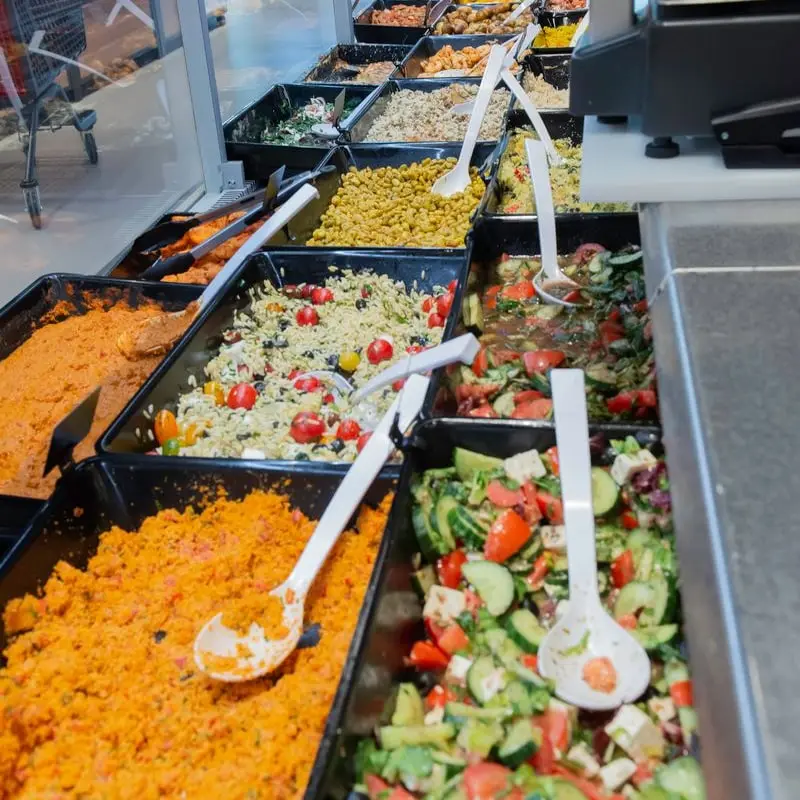
The menus start at six people, but the deli counter asks nothing of anybody. It is there every day: you point, we serve by the ladle, you leave with exactly what you want. It is also the best way to taste before ordering for ten.
Everything on the counter was cooked that same morning, in the kitchen beneath the shop. The dish climbs the stairs and lands on the counter: no lorry, no plastic tray.
The bottle that goes with it
Before you reach the till, make a detour via the wine merchant and tell him what will be on the table. He will pull out the bottle that goes with it, within the budget you give him: a Greek wine, a Portuguese white, an arak for those who want to finish the evening as if they were in Beirut.